
Nowadays, artificial intelligence seems to be everywhere, from chatbots to analysis of medical imaging, autonomous vehicles, scientific research, code generation, image generation, and more.
As an artist and former scientist, I find this fascinating. I’m aware that a lot of focus has been on the downside of AI - especially recently with the OpenAI-Hugging Face incident, but I also see potential huge advancements in science and health care. During my last years as a scientist, I was working on patient-specific computer modeling. With AI, the generation and application of those models to predict surgery and therapy outcomes will be greatly enhanced.
With regards to image generation, AI can generate images from a prompt in seconds. Not only can you ask it to create a photo of a dramatic sunset at your favorite location, it can also generate images in particular art styles, e.g. as an impressionist painting. In the beginning, AI wasn’t so good in representing people very well, but it has come very far since then.
Since I combine photography with traditional coloring and painting techniques, I’d like to focus on 2D art here. I think there is still an important difference between generating an image digitally, and creating a physical artwork by hand. To explain this, let me show you what I’ve done with a single photograph.
One Photograph, Many Interpretations
In 2015, I photographed my “Cardiff Dream” and “Cardiff Dream Too,” which is a view from the parking lot of Swami’s in Encinitas, California, towards Solana Beach:
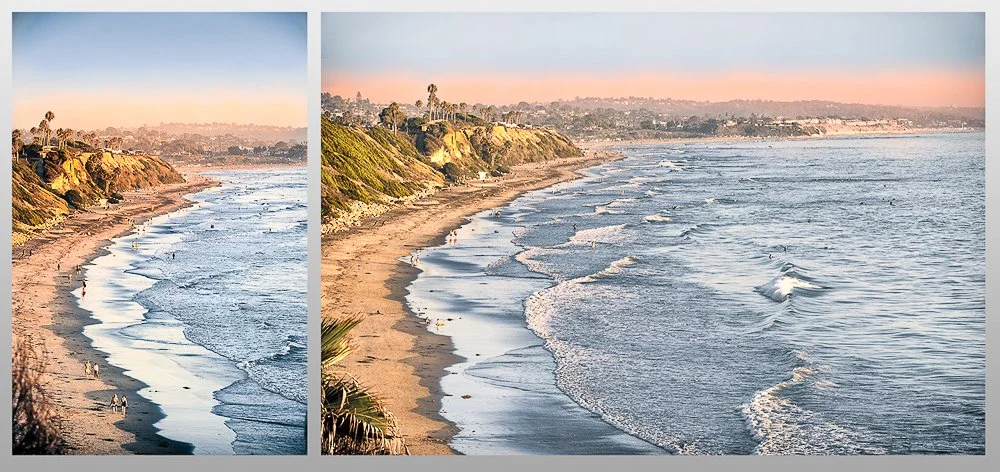
The original color photos of Cardiff Dream (left) and Cardiff Dream Too (right).
I photographed the scene with my DSLR in color, as I always do, and converted it to black and white later before hand coloring. You might wonder why I don’t shoot in black and white in the first place, as that is an option on modern digital cameras now, and that is because I want to be in charge and decide what is important in the scene — not the camera.
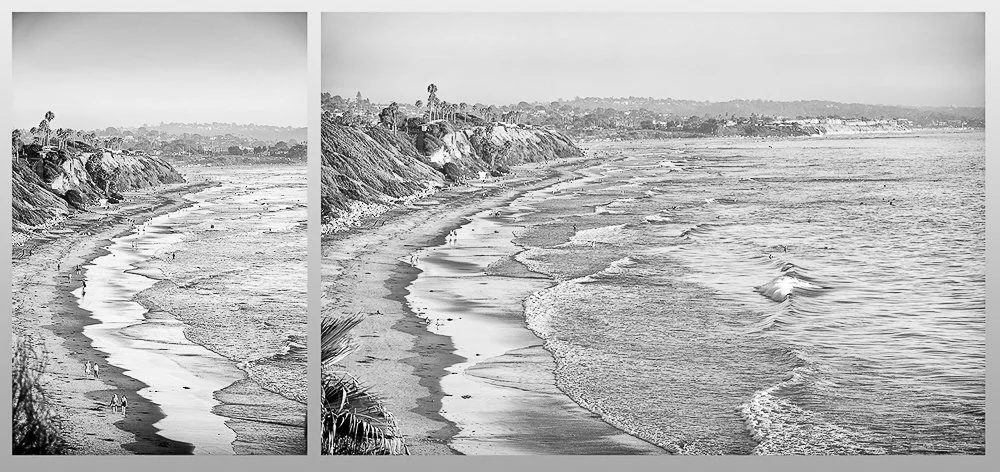
Black and white versions of Cardiff Dream and Cardiff Dream Too, before I start the coloring process.
AI can turn a color photo black and white for you too; however, it doesn’t know what someone wants to achieve with the photo.
When I convert to black and white, I carefully adjust the tonal values throughout the photo, which is an important part of the creative process. When a transparent paint color is added over a shade of gray, the resulting tone is determined by those two. Grays desaturate a color, so when I want to achieve a bright, saturated color, I need a lighter gray. A color on a white background will produce maximum saturation. Darker grays lead to deeper, more subdued tones. For example, if you are going for a bright blue sky, the sky in the black and white photo needs to be (almost) white.
In the days when I worked with film, these effects could be achieved by putting color filters on your camera lens. A red lens will lead to almost black skies, whereas a blue lens will give you bright ones.
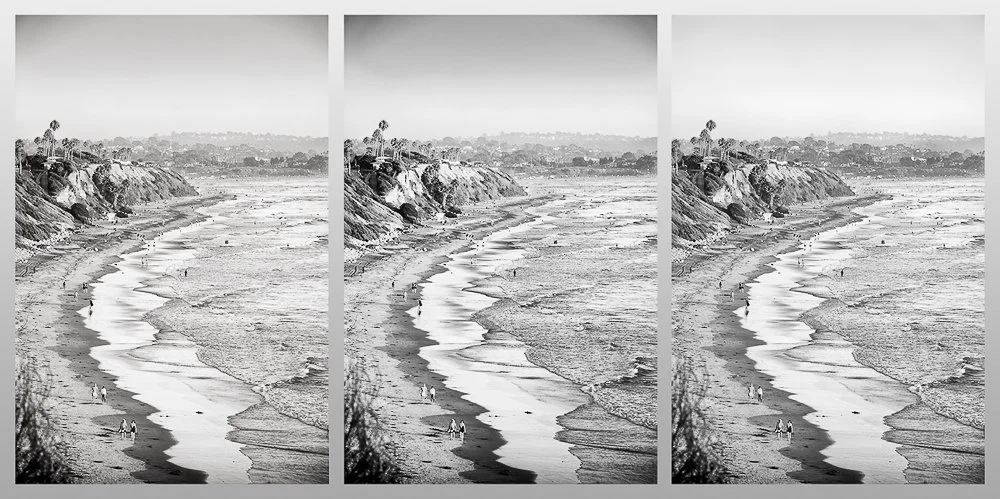
Examples of different gray scale values for Cardiff Dream.
Therefore, I have prepared different black and white versions of the same photograph, as it all depends on what colors and atmosphere I want to achieve.
A Physical Work of Art
For “Cardiff Dream” and “Cardiff Dream Too,” that gives me a range of possibilities. What color should the sky be? Should it be the same as the original scene, or should it turn into a sunset? Should the photo overall be more like a bright afternoon, or during a marine layer? The ocean can have many different colors too, from green to turquoise to deep blue.
Over the years, I have treated this photograph in many different ways. Even though I start with the same image, the finished artworks have their own personalities.
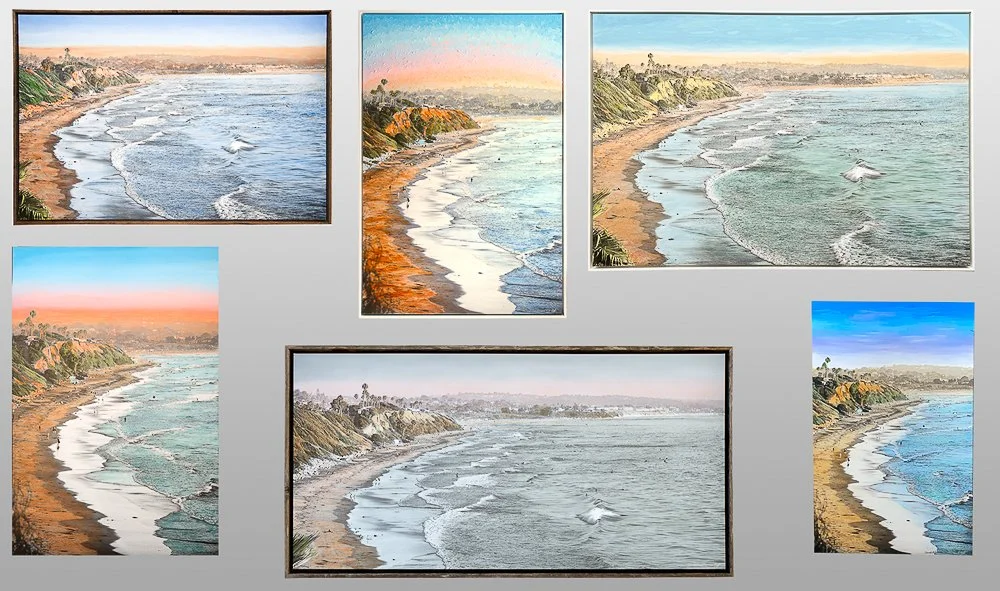
Different colorings and media for my “Cardiff Dreams”. Top left: Acrylic on canvas. I painted a sunset sky with opaque paint, whereas the rest was colored with transparent paint. Top middle: Oil on canvas. Here, the sky was painted with opaque oils with a palette knife and the rest colored with transparent oils. Top right and bottom left: Oil on canvas. Bottom middle: the sky was airbrushed with acrylics and the rest colored with transparent oils. Bottom right: The sky was painted with opaque acrylics and the rest colored with Marshall’s Photo Oils on photo paper.
Therefore, hand coloring a photograph is not simply a matter of recreating the original scene — although I could — it’s an opportunity to reinterpret the scene.
At this point, we are far ahead of what AI can do, because I am going to add physical paint to prints on paper or canvas. The process itself varies depending on the medium and substrates. On photographic paper, my favorite medium is still Marshall’s Photo Oils. These are oils that were created by the John G. Marshall company, founded in 1919 by Lucile Robertson Marshall. They are transparent and were specifically created to add color to black and white photographs and illustrations. I add them to my photos with cotton rounds and cotton swabs.
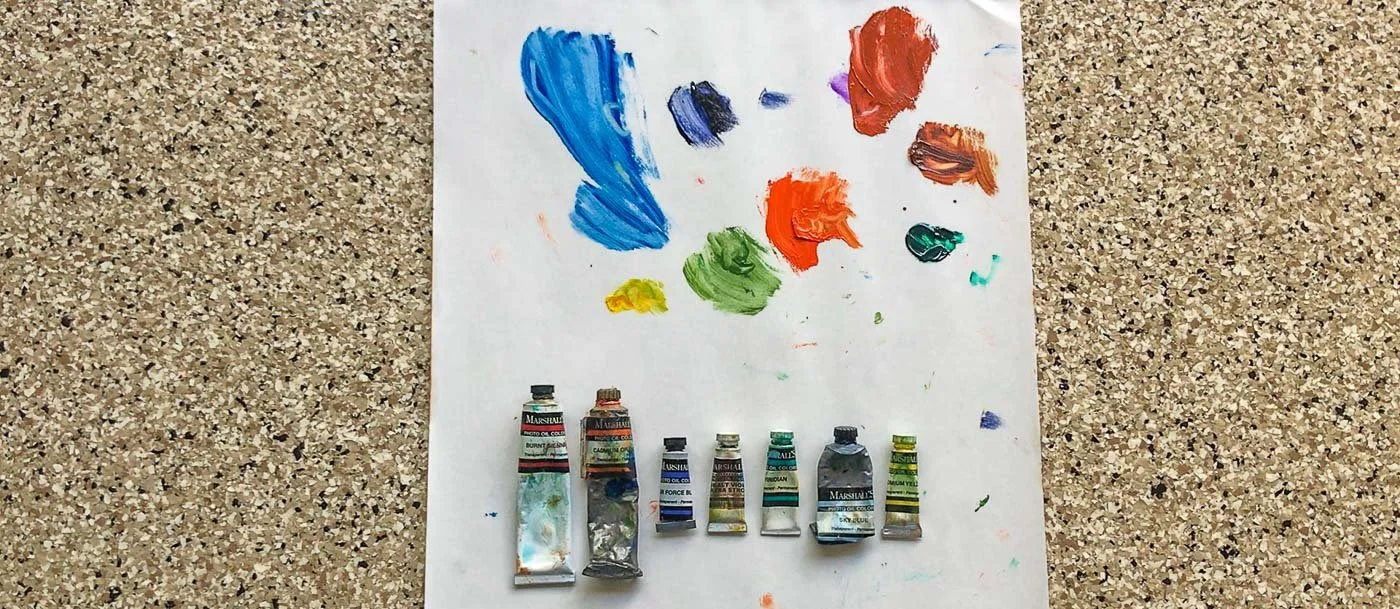
A set of Marshall’s Photo Oils that I used to color one of my pieces on photo paper.
On canvas, I work with traditional painting techniques to build atmosphere and color with thinned acrylics or regular thinned oil paints. On photo paper with the photo oils, I can achieve relatively uniform color fields. This is harder to achieve with transparent acrylics or oils on canvas because the brush strokes are often obvious. Of course that can be acceptable, but sometimes I — or a collector — would like to see a nice smooth sky. In that case, I revert back to opaque colors and paint in the sky with smooth transitions. On the other hand, with opaque paint, I can literally add another dimension, because now I can also add texture, using brushes or palette knives.
Hence, one particular photo will lead to many different versions, and no two originals are exactly alike. Even when I want to reproduce an earlier version, the brushwork and mixed colors will add subtle variations.
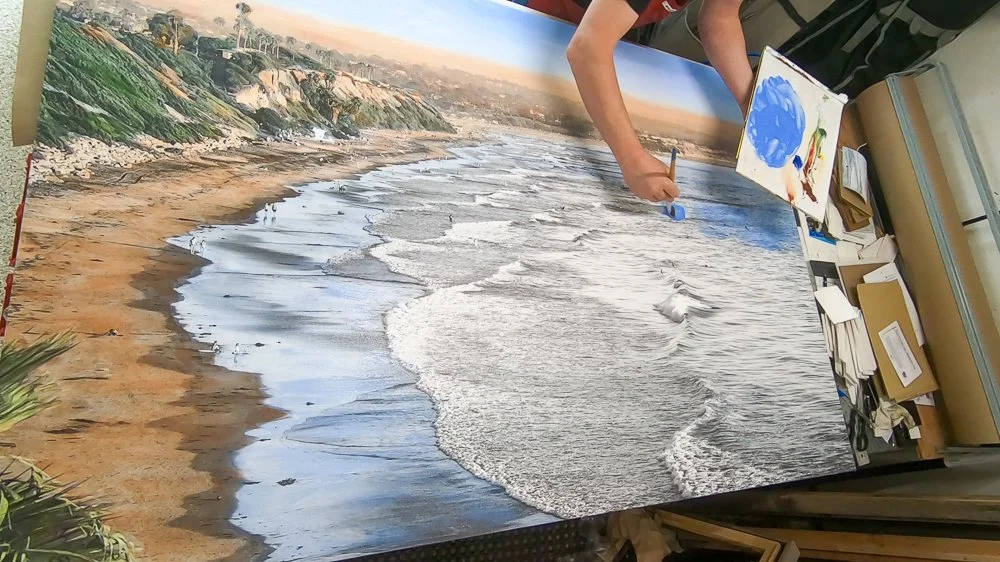
In the process of coloring with acrylics on canvas.
In addition to color, texture, medium, and substrate, two more decisions need to be made: size and presentation.
I have created “Cardiff Dream” and "Cardiff Dream Too” on large canvases, hand colored and as prints, as smaller framed and unframed pieces and in triptych form. Each presentation changes the way the viewer experiences the same scene.
They are physical objects, in which the many decisions regarding the texture of the paint, the scale of the artwork, and the materials used come together in a finished piece.
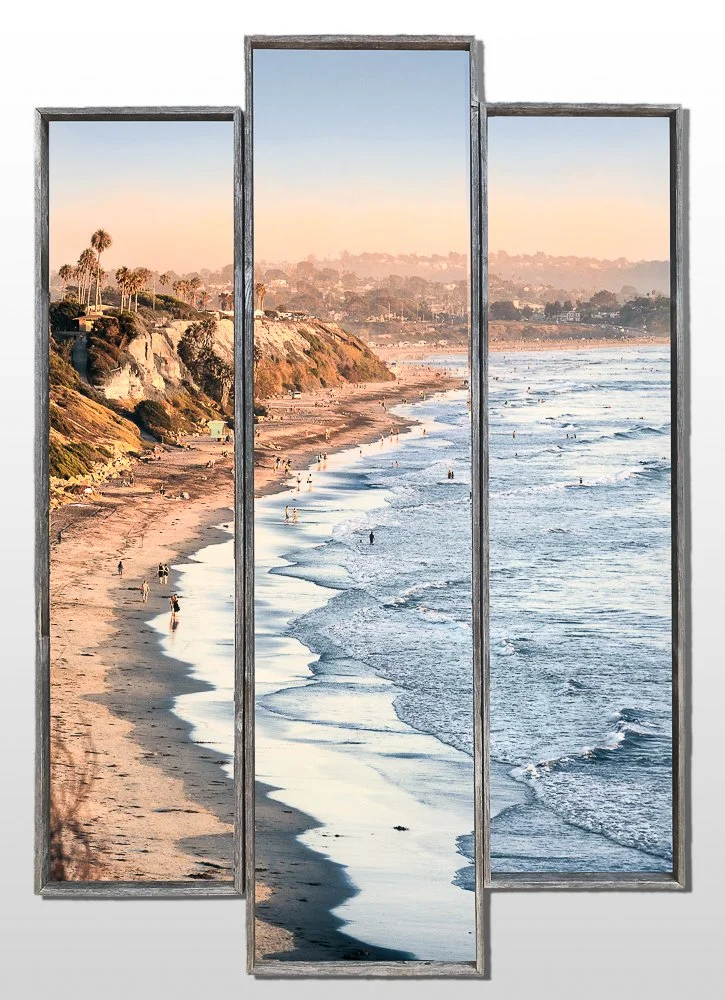
A triptych of Cardiff Dream.
If a Print Looks the Same, Why Buy the Original?
A question I get asked regularly is: “Can you show me the difference between a hand colored original and a print?”
I explain that I also make fine art prints of my originals: I take a photo of a hand colored piece and white balance it. The visual differences between a high-quality reproduction and the original can be virtually impossible to distinguish. With exception of texture, the colors, details, and the overall appearance can be remarkably similar.
My wife always finds it amusing when I mention this. She thinks it sounds as if I’m trying not to sell my hand colored originals!
I then emphasize that on the other hand each original is unique. In most cases, people choose the original. They choose it because they want to own the actual artwork I colored by hand. There’s something special about knowing that the colors were applied by hand, that the brushstrokes and subtle variations belong to this particular piece, and no other artwork will be exactly the same.
AI makes it increasingly easy to generate and reproduce beautiful images, but the distinction between an image and a physical object is meaningful. When almost anyone can generate an image in seconds, the fact that an artist spent hours, days, or weeks creating something by hand makes handmade artwork more appreciated. Time alone doesn’t make an artwork necessarily more valuable, but in addition for knowing how something was made and who made it, does matter.
Moreover, the personal connections with the places, as well as the people who choose to bring my artwork in their homes adds to how valuable a piece can be.
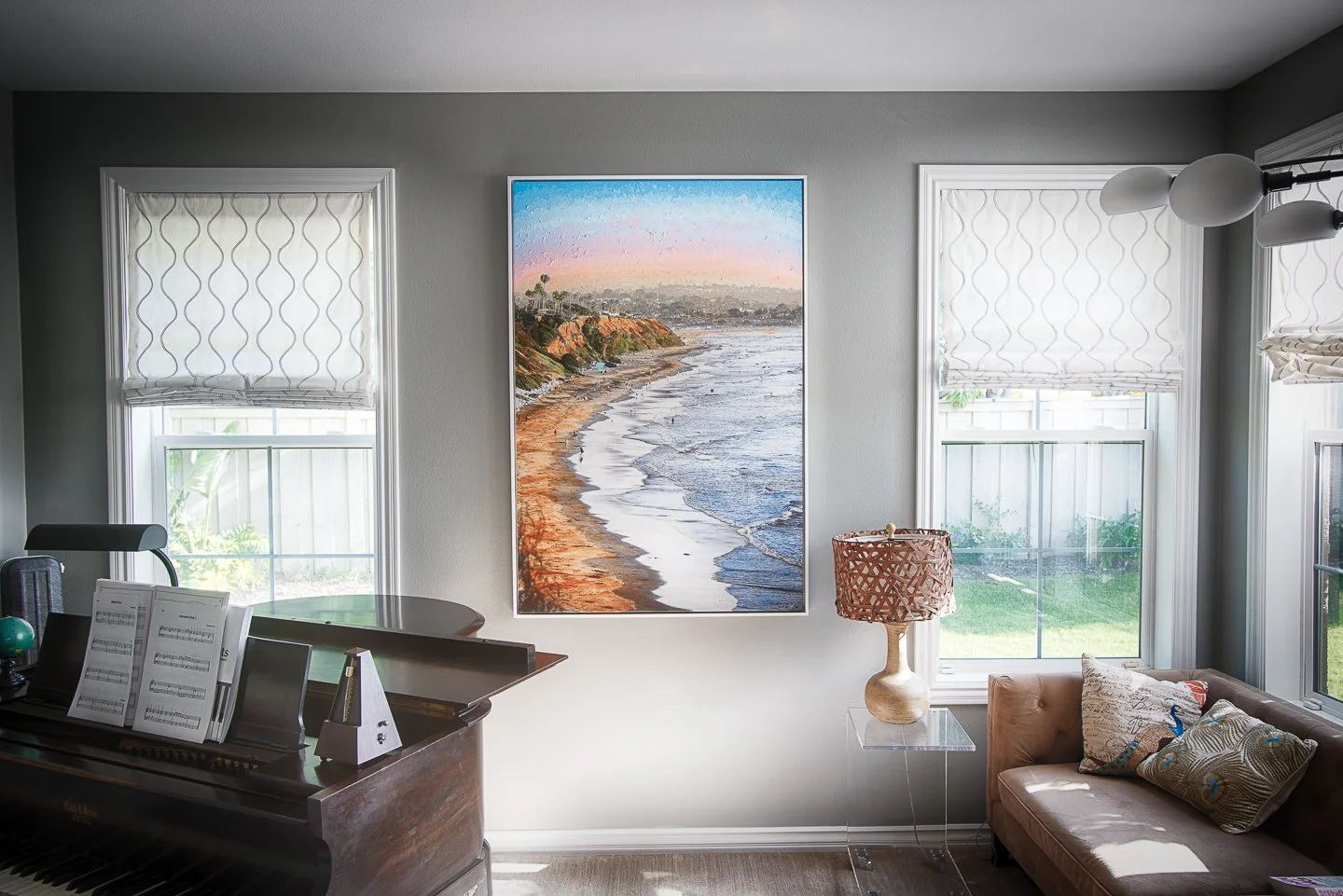
Cardiff Dream on the wall.
Explore my Encinitas photography and fine art, or contact me to discuss a custom hand-colored interpretation of one of my photographs.